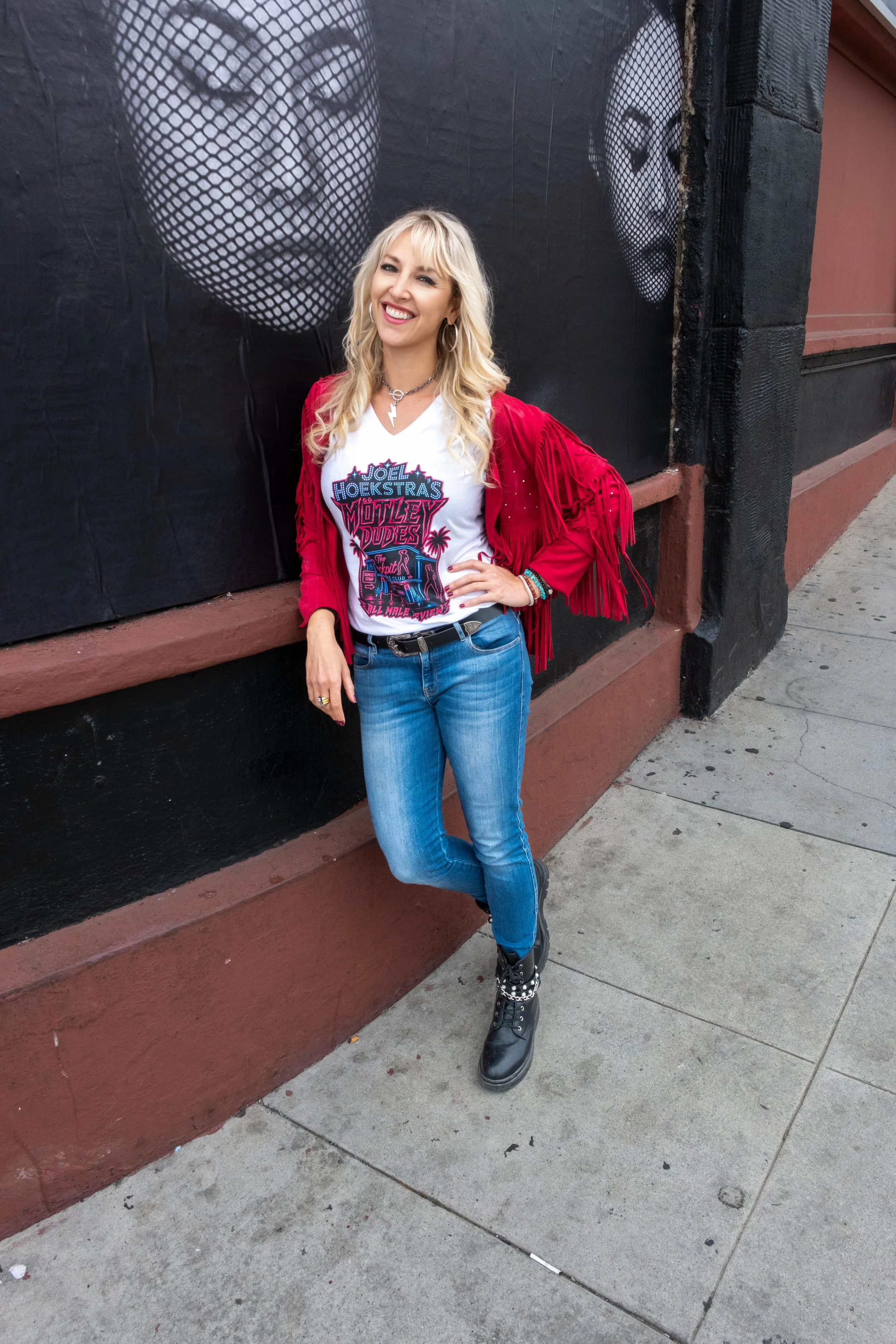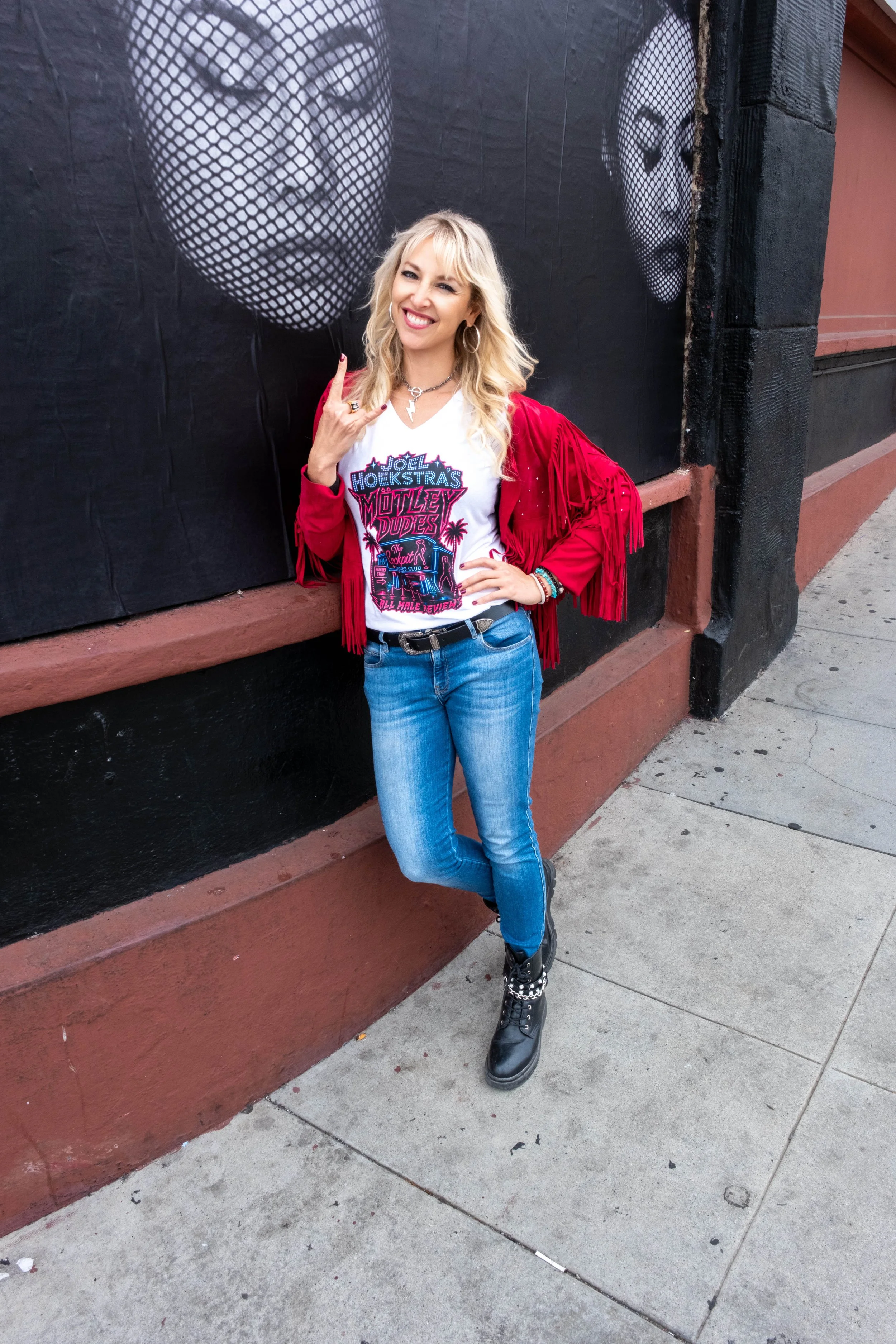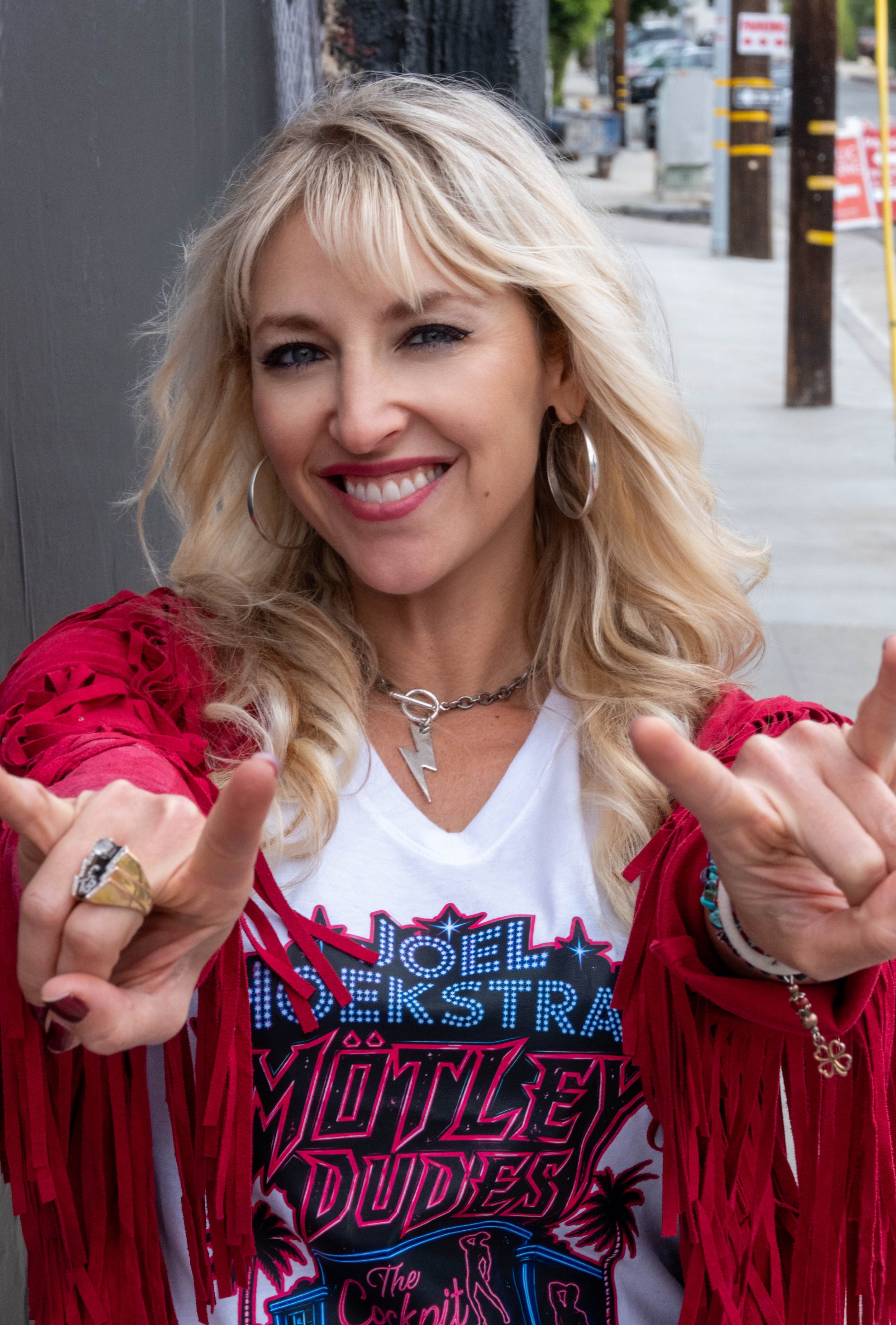
Britt Lightning Is Keeping the Torch Lit
By: Will Sparks
Photos: Mark Pontz
There is a certain kind of musician who enters a room with the easy confidence of someone who has earned every note. Britt Lightning, lead guitarist of Vixen, carries that energy naturally. She is warm, quick to laugh, and fully aware of the lineage she is part of—not just as a guitarist in one of rock’s most enduring all-female bands, but as a player helping push the electric guitar into its next era.
Lightning’s path to Vixen began, appropriately enough, onstage.
After moving from Boston to Los Angeles, she immersed herself in the city’s jam scene, a musical culture that did not exist in quite the same way back home. In Los Angeles, open jams were not just casual nights out. They were proving grounds, networking hubs, and living showcases where musicians could step up, plug in, and make themselves known. “That is really how I got started,” Lightning says. “Any musician can just go and get to meet other local musicians and jump up and kind of showcase.”
By 2017, Britt Lightning was in Vixen.
Nearly a decade later, she is still there, standing beside drummer Roxy Petrucci as the band continues to carry its legacy forward. Asked how long Roxy plans to keep Vixen going, Lightning does not hesitate.
“Forever,” she says with a laugh. “She’s keeping the torch going.”
For Lightning, that torch is both history and momentum. Vixen is not simply a nostalgia act, nor is it a museum piece from the glam-metal era. It is a working rock band with a living audience, an active tour schedule, and a place in a broader conversation about where guitar music is headed.
That conversation becomes especially interesting when Lightning talks about women in rock.
There was a time when female guitarists were treated as exceptions. A handful of names were brought up repeatedly—Nancy Wilson of Heart as a (then) rare example—while the larger culture of electric guitar remained overwhelmingly male. Lightning knows that world well. When she was younger, boys in a school guitar club did not want her to jam with them because she was a girl.
Her response was not to shrink. It was to sharpen.
“I was like, ‘Oh, well, if that’s the case, I’m gonna listen to exactly what you play outside the door,’” she remembers. If they were learning Metallica, she would go home, master the song, and come back stronger.
That defiance helped shape her as a player.
“The thought that maybe girls can’t play helps to fuel females to be better players,” she says. “I know it helped me.”
Today, the landscape looks very different. Lightning points to social media as one reason. Young girls no longer need to wait until a female guitarist appears in their town, on their local stage, or on mainstream television. They can see players like Nita Strauss tearing up arenas with Alice Cooper, or discover countless women posting performances online, going viral, and proving—in real time—that guitar has no gender.
“When you’re not seeing people, if you’re a young girl and you’re not seeing other girls doing it, then you don’t really know it’s an option,” Lightning says. “With social media, people can post things and share, and things go viral. Seeing Nita Strauss playing with Alice Cooper, it’s like, wow, I can do that.”
That shift is not theoretical. Lightning recently judged a middle school Battle of the Bands and noticed something remarkable: every single band had at least one girl in it, whether on bass, guitar, or vocals.
“I was like, this is amazing to see,” she says.
It is a full-circle moment for someone whose own entry point into guitar came through one of rock’s most iconic male players. Lightning first picked up the instrument at 15 after hearing Eddie Van Halen’s “Eruption.”
“I was like, whoa, what is this?” she says. “Prior to that, I listened to hip hop. When I heard ‘Eruption,’ I was like, okay, this is it. This is my new path.”
She laughs at the contrast.
“I went from the Notorious B.I.G. to the Notorious EVH.”
That sense of humor is part of Lightning’s charm. Though she was raised in Boston, she does not have the thick Boston accent people sometimes expect. Her parents were not from the city, so the accent was not part of the household soundtrack. Still, some loyalties remain: Dunkin’, the Patriots, Ben Affleck, Matt Damon, Good Will Hunting, The Town. The Boston roots are there, even if the vowels are not.
Outside of Vixen, Lightning is also writing and recording original music again. She is working on a rock-pop project with singer Tommy London, who is also her boyfriend—despite a strange internet rumor that the two are married.
“There was a fake website with photos and all sorts of things,” she says. “Everybody’s telling me congratulations. I’m like, what?”
The project, not yet publicly named at the time of the interview, has given her a chance to return to original material after years of touring, performing, and keeping multiple musical worlds in motion.
“It’s just great to write original material again,” she says. “It’s been a while since I’d done a lot of my own stuff. It’s been a blast.”
The first music video, she says, is expected to arrive in the summer.
Another major part of Lightning’s life is Rock ‘n’ Roll Fantasy Camp, the long-running experience founded by David Fishof in 1996. Now celebrating its 30th anniversary, the camp gives musicians of all levels the opportunity to form bands mentored by rock-star counselors, jam with their heroes, and perform at legendary venues.
Lightning helps run the camps day to day, coordinating the moving pieces that allow campers to have the kind of experience most fans only dream about. At a recent camp, participants were set to play the Viper Room and Whisky a Go Go, and had the opportunity to perform with members of Mötley Crüe.
For Lightning, the reward is not necessarily getting to jam with every headliner herself. It is watching the campers have their moment.
“The joy of doing the camp is watching everybody experience their moment and see everybody smile,” she says. “That’s really what does it for me. I’m just happy to help make that dream come to life.”
That spirit says a great deal about Britt Lightning. She is a serious guitarist, a natural performer, and a visible part of a growing wave of women helping redefine rock musicianship. But she is also someone who understands that music is not only about individual spotlight. It is about transmission: passing along confidence, opening doors, keeping the stage alive for the next player.
In Vixen, she helps preserve and expand the legacy of a band that broke ground for women in hard rock. Through Rock ‘n’ Roll Fantasy Camp, she helps everyday musicians step into extraordinary moments. Through her own original work, she is continuing to evolve as an artist.
And through her guitar playing, she remains part of a larger movement—one in which young girls no longer have to ask whether they belong in the room.
They already do.
Vixen tour dates and information can be found at vixenofficial.com. Rock ‘n’ Roll Fantasy Camp information is available at rockcamp.com.